Terrace Survey
The Colca Valley is deeply incised offering ready access to a diversity of ecozones suited to both crop cultivation and camelid pastoralism within just a few hours walk. By the time of the Spanish conquest, the valley was one of the most densely terraced regions in the Americas. Rapid elevation changes allow farmers to cultivate lowland crops such as maize, chilis and lucuma, lower in the valley and highland crops including potatoes and quinoa higher up and within a relatively compressed vertical ecotope. Steep valley slopes also provide ready access for grazing camelid herds to the vast high-altitude puna where dry grasses and shrubs are punctuated by marshes and anthropogenic wetland. Ethnohistoric records of vast camelid herds highlight how productive this region has been for herding.


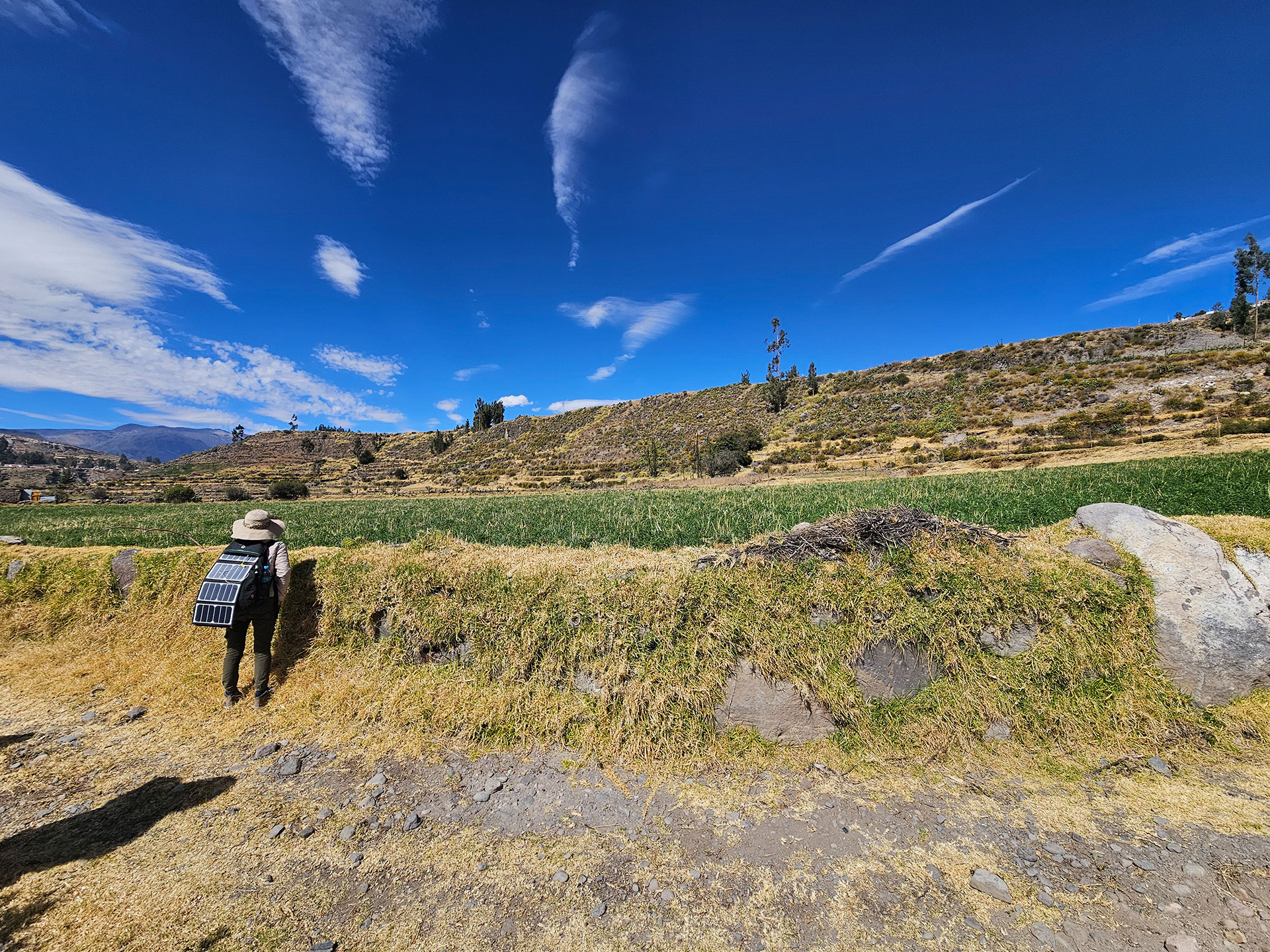
In July and August of 2024 our team of about eight archaeologists from the US and Peru in pedestrian survey for four weeks. First, we identified terrace complexes around Achomaniy from satellite imagery. In total we targeted 32 distinct complexes. These ranged from high-elevation fields in the puna on the periphery of the valley all the way to the Colca River. Then we set out in our truck and on foot with tablets in hand and cameras to collect attributes on the particulars agricultural terraces within each complex. In total we collected attributes on 134 agricultural fields and terraces.
Our initial results are summarized in our Final Report presented to Peru’s Ministry of Culture (Spanish only).
Fast Facts
- Complexes analyzed: 32
- Fields analyzed: 134
- Field types identified:
- 112 bench terraces
- 15 sloping field terraces
- 7 other
- Irrigated fields: 84
- Minimum riser height: 0m
- Maximum riser height: 5.83m
- Average minimum riser height: 1.18m
- Average maximum riser height: 2.03m
- Minimum elevation: 3268masl (10721fasl)
- Maximum elevation: 3976masl (13045fasl)
- Average elevation: 3532masl (11588fasl)
- Use:
- 27 abandoned
- 39 fallow
- 67 in use
- Surface collection: 43 fields
- Masonry types:
- 81 random rubble unworked
- 61 course rubble unworked
- 2 random rubble split
- 6 course rubble split
- 4 other (mud brick, no bricks, eroded)